
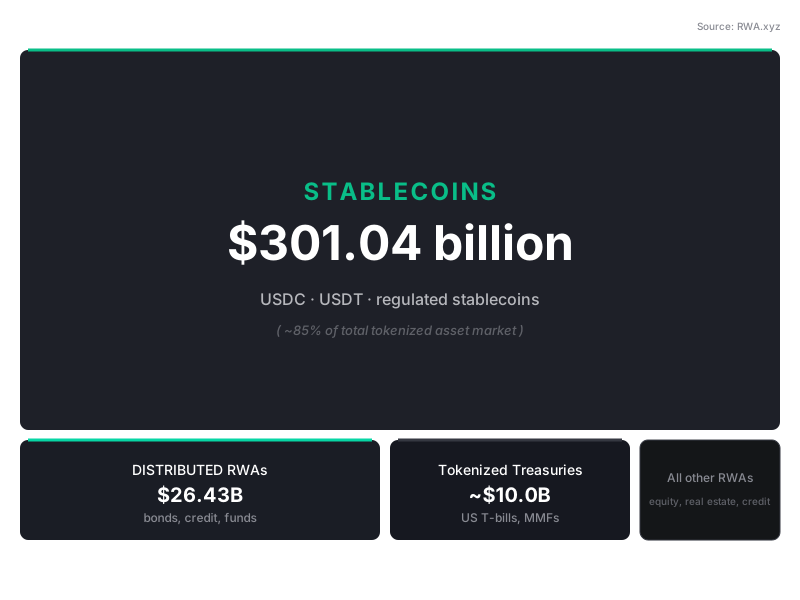
Tokenization does not magically create liquidity. A tokenized asset becomes liquid only when primary issuance, secondary market-making, cash-like settlement, and distribution rails work together to turn a digital wrapper into a market. In 2026, the liquid core is still concentrated in Treasury-like and cash-like products rather than the long tail of “everything on-chain”: RWA.xyz shows $26.43B of distributed RWAs, $301.04B of stablecoins, and roughly $10B of tokenized U.S. Treasuries, while the World Economic Forum and McKinsey still point to legacy infrastructure, regulatory fragmentation, limited interoperability, and liquidity as the bottlenecks to scale.
Who this is for: Brokerage CTOs, exchange operators, dealing desks, product managers, and liquidity teams evaluating how tokenized assets will plug into centralized trading and financial infrastructure.
What you’ll learn:
- Where tokenized-asset liquidity is actually sourced today
- Why the cash leg matters as much as the asset leg
- How centralized operators should think about normalization, distribution, and failover
A simple mental model
Markets are plumbing with a price attached.
That sounds almost offensively reductive, but it is the right way to think about tokenized assets. The industry spends a lot of time talking about issuance, wrappers, chains, and standards. The harder question is more mundane: who can quote size, who can warehouse risk, who can redeem the instrument, what settles the cash leg, and how does that price reach an exchange, broker, or OMS that real users already operate?
Three definitions help.
Liquidity hub. A liquidity hub is the layer between sources and destinations. It ingests quotes or order books from upstream venues, normalizes them, applies distribution logic, and republishes them to downstream trading platforms or market-data consumers.
Normalization. Normalization is the work nobody tweets about and everybody eventually pays for: symbol mapping, tick sizes, price precision, quantity precision, timestamps, quote conventions, session logic, and instrument metadata.
Execution model. Execution model is the rulebook for what happens when a price becomes an order. Who is maker or taker? Is the flow passed through, internalized, or partially hedged? Is there smart routing, simple source prioritization, or just operational failover?
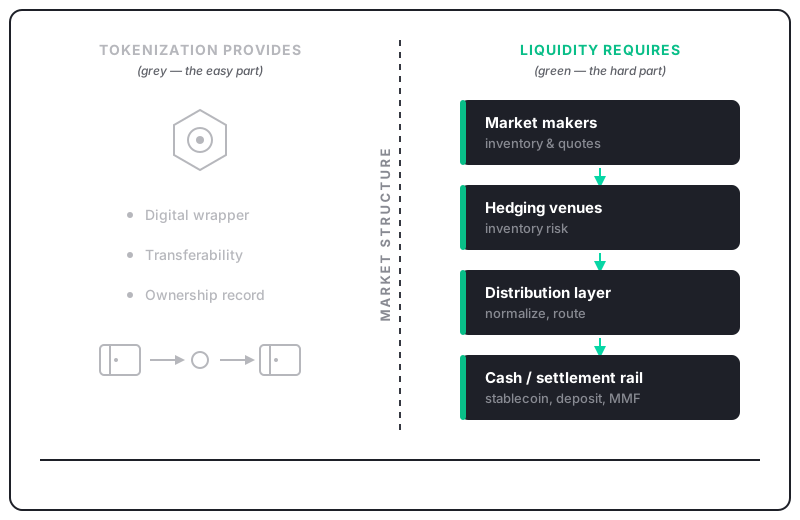
That lens matters because tokenization is issuance. Liquidity is a market-structure outcome.
Liquidity starts at issuance and inventory, not at the token contract
The cold-start problem in tokenized assets is simple: a token with no reliable issuer liquidity, no dealers, and no hedging venue is just a static digital wrapper.
The market’s favorite category error is to confuse transferability with liquidity. A token that can move between wallets is not necessarily a token that can absorb size without blowing out the spread. That is effectively the same problem described by the World Economic Forum and McKinsey: adoption is slowed by legacy infrastructure, regulatory fragmentation, limited interoperability, and liquidity issues, while true scale requires a coordinated value chain rather than just a token launch.
- Primary issuance and redemption create the anchor price or NAV.
- Market makers and OTC desks quote around that anchor and manage inventory risk.
- Hedging venues and collateral rails reduce the cost of holding that risk.
- Distribution layers turn that supply into accessible price and size for brokers, exchanges, and institutional clients.
Common pitfalls: confusing token creation with secondary-market depth; launching without credible redemption mechanics; assuming a listing equals distribution; and ignoring the absence of a real cash or collateral leg.
The liquid core today is mundane by design
The tokenized assets with the most real traction are the ones institutions already understand as cash-like or near-cash: Treasuries, money market funds, stablecoins, and regulated deposit-style claims.
The liquid core is not the most exotic part of tokenization. It is the most legible part. RWA.xyz’s global overview shows $26.43B in distributed RWAs and $301.04B in stablecoins, while its Treasuries page shows roughly $10.00B in tokenized U.S. Treasuries. Franklin Templeton’s Benji platform describes FOBXX as the world’s first U.S.-registered onchain money market fund.
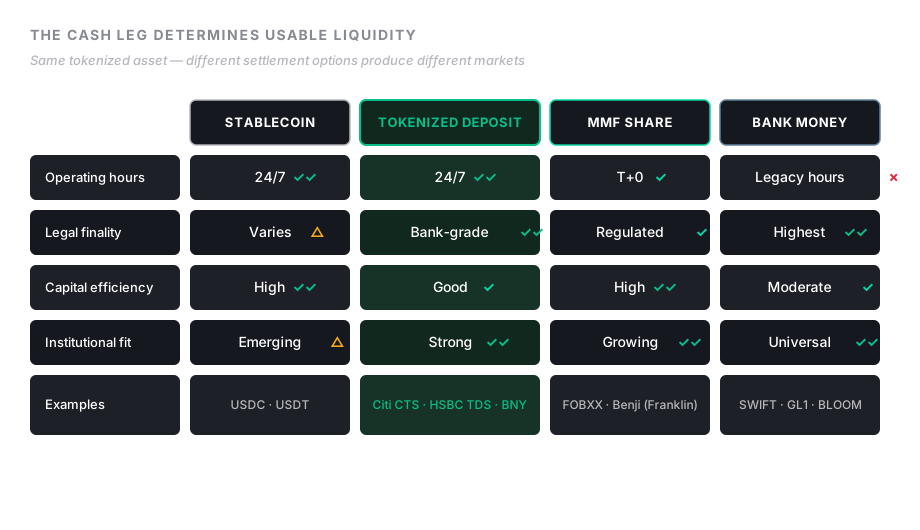
A recent example is also the most revealing one. On February 11, 2026, Franklin Templeton and Binance said eligible clients could use Benji-issued tokenized money market fund shares as off-exchange collateral on Binance, with the assets remaining in regulated custody and their value mirrored inside the trading environment. That is how tokenized liquidity gets distributed in the real world: through custody, collateral, and access, not slogans.
- Cash-like instruments have clearer valuation anchors and redemption windows.
- Dealers are more comfortable warehousing inventory in products with predictable duration and credit risk.
- Institutions can plug them into treasury, margin, and funding workflows more easily than bespoke long-tail RWAs.
- Distribution improves when the economic utility can travel without forcing the asset itself onto the venue.
Common pitfalls: treating all RWAs as equally liquid; assuming a NAV-based product should trade like a 24/7 crypto spot pair; ignoring eligible-investor, custody, or jurisdictional constraints; and overestimating demand for assets with weak collateral utility.
Distribution is increasingly centralized and API-first
Institutional tokenized-asset distribution is being built less like an onchain free-for-all and more like a new layer of regulated market infrastructure wired into familiar venues, custodians, and APIs.
If you zoom out, the pattern is obvious. tZERO Connect is pitched as direct, programmable access to regulated infrastructure for digital securities and tokenized RWAs. BNY and Goldman Sachs launched a tokenized MMF solution to maintain a blockchain-based ownership record for select money market funds. Swift moved from experiments to live digital-asset transaction trials in 2025 and then completed a tokenized-bond interoperability trial in early 2026. Franklin Templeton and Binance extended tokenized MMFs into centralized off-exchange collateral. The common theme is not “everything moves to DeFi.” The common theme is “make digital assets consumable inside existing institutional workflows.” That is what scale looks like in finance. Not a new app. A new pipe that plugs into the old system with less friction than the old system can manage on its own.
- Issuers or venues expose API-driven access to issuance, trading, or entitlements.
- Custodians or venue partners mirror ownership or collateral rights into trading environments.
- OMS, EMS, exchanges, and broker platforms connect over familiar interfaces such as FIX or institutional APIs.
- Settlement occurs through whichever combination of stablecoins, tokenized deposits, MMF shares, or bank rails the jurisdiction will accept.
Common pitfalls: assuming wallet transferability equals operational distribution; underestimating entitlement, KYC, and custody segregation requirements; forgetting that price distribution and reference data still need normalization; and treating centralized consumption as an afterthought.
In tokenized assets, the cash leg is the market structure
If the asset leg is tokenized but the cash leg is fragmented, slow, or institutionally unusable, liquidity stalls.
Most tokenization commentary still focuses on the asset wrapper. Institutions are increasingly focused on the settlement asset. That is the right instinct. Citi integrated Citi Token Services with 24/7 USD Clearing for multibank instant payments and later expanded CTS to support euro transactions from Dublin. HSBC launched Tokenised Deposit Service in Hong Kong for real-time, always-on HKD and USD payments between corporate wallets. BNY’s Digital Cash creates on-chain book entries representing clients’ demand deposit claims on BNY’s private, permissioned blockchain. HKMA’s latest pilots and Ensemble TX are explicitly focused on tokenized deposits, tokenized money-market-fund transactions, and real-time liquidity and treasury use cases. BIS Project Agorá is exploring tokenized commercial-bank deposits plus central-bank reserves because final settlement still matters.
That is why tokenized deposits, MMF-based settlement models, and other regulated digital-cash equivalents matter so much. They are not side dishes. They are the table.
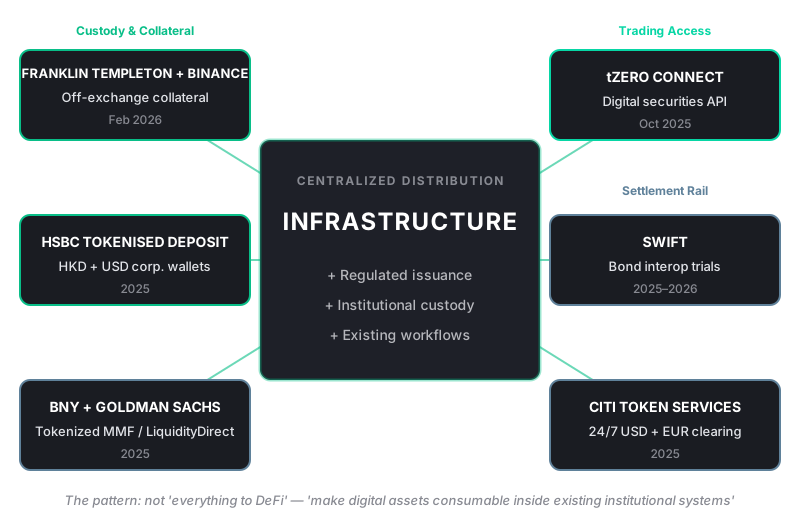
- The market chooses its settlement asset: stablecoin, tokenized deposit, MMF share, or central-bank-linked money.
- That choice shapes operating hours, credit exposure, and jurisdictional fit.
- Once the cash leg is credible, the asset becomes easier to finance, pledge, transfer, and quote at tighter spreads.
- Once the cash leg is weak, every other part of the stack becomes more expensive.
Common pitfalls: dreaming about T+0 while the cash leg still operates on legacy cutoffs; ignoring where legal finality actually sits; fragmenting liquidity across ledgers with no interoperable settlement asset; and forgetting that downstream systems need more than bid and ask.
The winning architecture is unglamorous: normalize, prioritize, distribute, monitor
If tokenized assets are going to scale in centralized systems, the decisive capability is not chain maximalism. It is operational market structure.
MAS’s GL1 whitepaper says limited interoperability and incompatible infrastructures trap liquidity across venues and increase funding and opportunity costs. That observation is not academic. It is the whole reason distribution layers exist. Publicly, B2CONNECT’s own positioning pulls in the same direction: normalize the feed, distribute it to downstream platforms, and keep backup sources ready. In early markets, disciplined source prioritisation and failover usually matter more than swagger about omniscient routing. That is not glamorous work. It is the work that survives contact with clients.
- Normalize symbols, price increments, size precision, timestamps, and session rules.
- Define source priority and failover behavior before scale, not after the first outage.
- Separate market-data distribution from execution logic and risk logic.
- Monitor stale quotes, fill quality, and deviations from fair value or NAV.
- Keep the distribution layer simple enough for brokers, exchanges, and OMS/EMS stacks to consume.
Common pitfalls: chasing smart order routing before fixing data hygiene; mixing instruments with very different valuation cadences inside one quote model; pretending “aggregated liquidity” exists when there is only superficial connectivity; and assuming every downstream platform can natively interpret tokenized instrument semantics.
Proof: a practical sourcing-and-distribution map
Here is the simplest way to test whether a tokenized-asset market is real or merely issued.
Issuer / fund / bank deposit rail
    -> creates and redeems the instrument
    -> publishes NAV, reference value, or settlement terms

Market maker / OTC desk / prime service
    -> warehouses inventory
    -> quotes two-way risk
    -> hedges where possible

Venue / ATS / exchange / collateral programme
    -> exposes client access
    -> translates ownership or collateral rights into tradable utility

Liquidity hub / normalization layer
    -> maps symbols, precision, timestamps, session logic, and reference data
    -> distributes price and trading access to brokers, exchanges, OMS/EMS, and market-data consumers

Cash / collateral rail
    -> stablecoin, tokenized deposit, MMF share, or bank money
    -> determines finality, capital efficiency, and operating window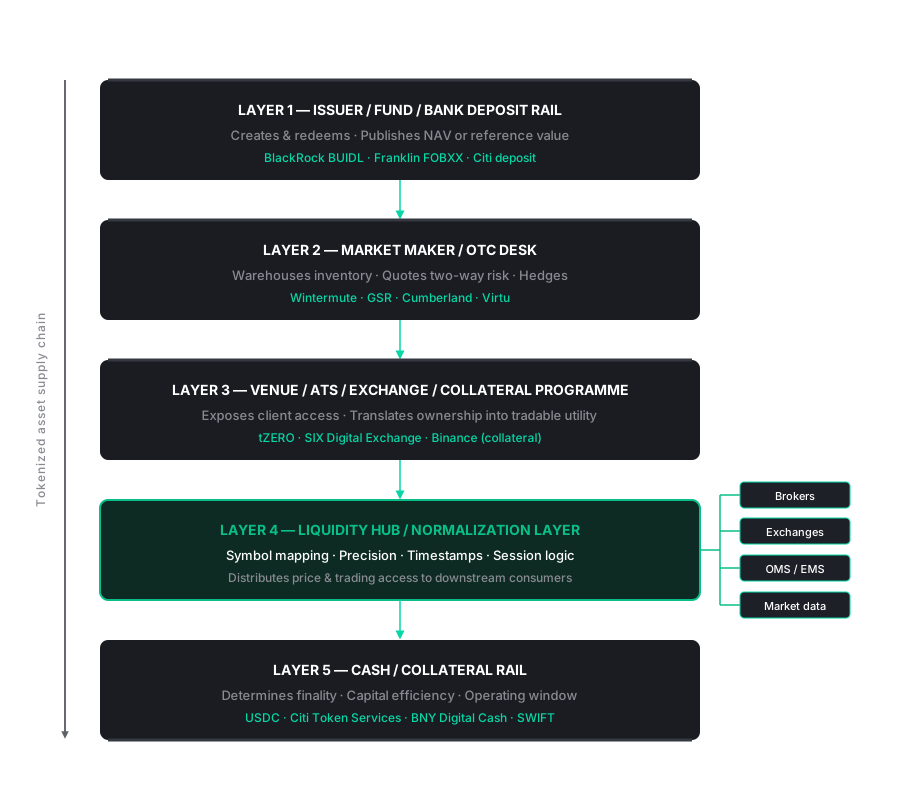
Example scenario: a brokerage wants to accept a tokenized money market fund as collateral for a leveraged crypto strategy. The issuer defines creation and redemption. A custodian holds the MMF shares. The venue mirrors collateral value into the trading environment. A distribution layer normalizes symbol, valuation timestamp, haircut logic, and eligibility flags for the downstream platform. The cash leg settles through a bank-grade rail or another acceptable digital cash equivalent. Remove any one of those layers and the “liquidity” largely disappears. Franklin Templeton’s February 2026 Binance integration is a live illustration of that model.
The table below is the due-diligence version.
| Question | Why it matters |
|---|---|
| Who creates and redeems the asset? | No redemption path, no anchor for pricing |
| Who makes a two-way market? | A listed asset without dealers is not a liquid asset |
| What is the cash leg? | Settlement quality drives usable liquidity |
| Where does hedging happen? | Inventory with no hedge becomes expensive inventory |
| How is the product distributed? | APIs, custody, entitlements, and venue access matter |
| What happens when the primary source fails? | Real markets are judged on bad days, not demo days |
A useful mental shortcut: tokenization solves legibility faster than it solves market depth. Distribution is the layer that closes that gap.
FAQ
Does tokenization itself create liquidity?
Which tokenized assets look most liquid today?
Why are tokenized MMFs and Treasuries moving faster than tokenized equities or real estate?
Is DeFi the main distribution channel for tokenized assets?
Why do tokenized deposits matter so much?
What is the difference between sourcing liquidity and distributing liquidity?
What should a brokerage or exchange check before integrating a tokenized asset?
Where does B2CONNECT fit today?
Key Takeaways
- Tokenization is issuance. Liquidity is market structure.
- The liquid core today is cash-like, Treasury-like, and collateral-friendly.
- The cash leg matters as much as the asset leg.
- Institutional distribution is increasingly centralized, API-first, and custody-aware.
- The winners will be the unglamorous infrastructure providers that make tokenized instruments usable inside existing financial systems.
If you are evaluating a liquidity hub for centralized digital-asset distribution, talk to the B2CONNECT team, explore the docs, and read the release notes before you buy the story. In tokenized assets, the plumbing is the product.
References
- World Economic Forum, “Asset Tokenization in Financial Markets: The Next Generation of Value Exchange”
- McKinsey, “From ripples to waves: The transformational power of tokenizing assets”
- RWA.xyz, “Global Market Overview”
- RWA.xyz, “Tokenized U.S. Treasuries”
- Franklin Templeton, “Invest with Benji”
- Franklin Templeton, “Institutional Off-Exchange Collateral Program with Binance”
- Citi, “Citi Token Services and 24/7 USD Clearing”
- HSBC, “Tokenised Deposit Service for Corporate Cash Management in Hong Kong”
- BNY, “Digital Cash Capabilities for Institutional Clients”
- BNY & Goldman Sachs, “Tokenized Money Market Funds Solution”
- Swift, “Live trials of digital asset transactions on Swift”
- Swift, “Digital finance interoperability trial for tokenised bonds”
- HKMA, “Project Ensemble / Ensemble TX”
- BIS, “Project Agorá”
- Monetary Authority of Singapore, “GL1 Whitepaper”
- tZERO, “tZERO Launches tZERO Connect”
- B2CONNECT, Documentation and Release Notes
B2CONNECT Product Team · Last updated: March 2026